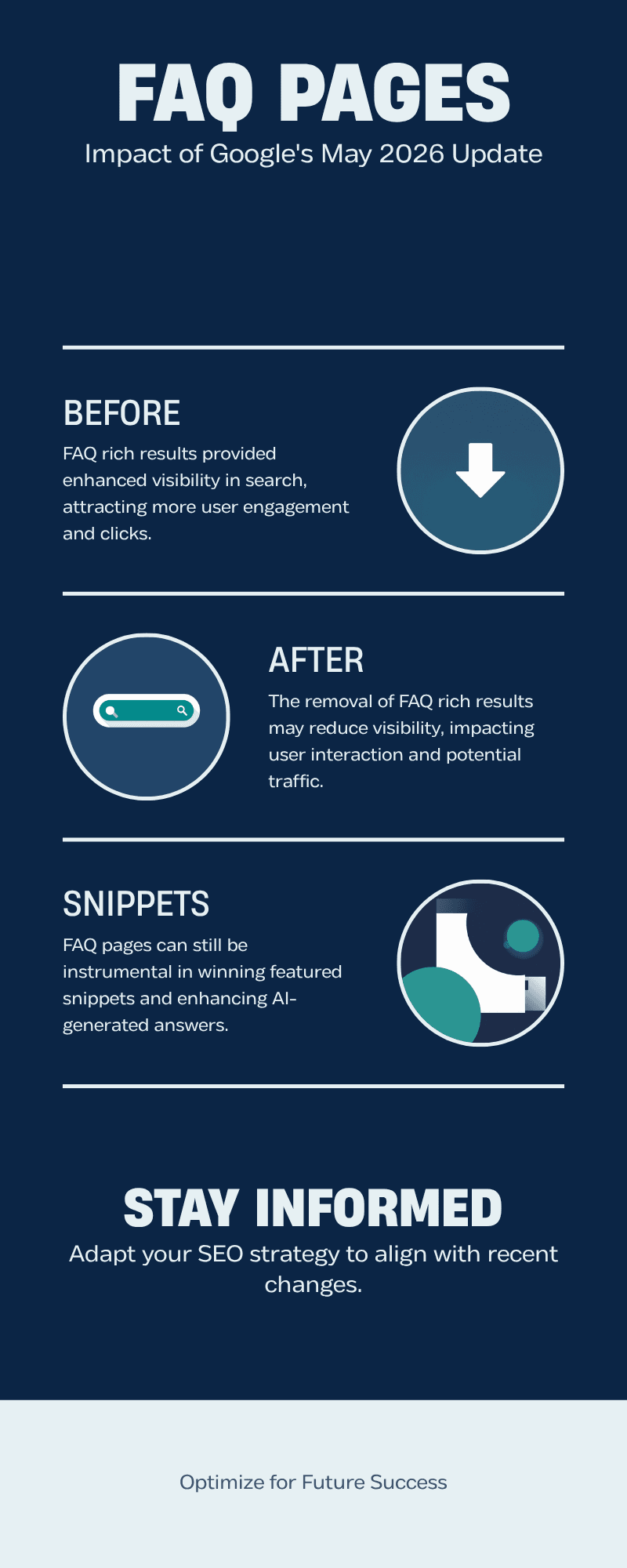
For years, the advice on FAQ pages was simple: add FAQ schema, get an expandable dropdown under your listing in Google, win extra space on the results page. That advice is now out of date. Google confirmed the change to its Search Central documentation, and Search Engine Journal reported that FAQ rich results stopped appearing in Google Search from 7 May 2026. So does a Melbourne business still need an FAQ page? Yes, for reasons that have nothing to do with the dropdown you have lost, and arguably more important ones now that AI-generated answers are becoming a real source of enquiries.
What actually changed in May 2026
Google’s own FAQPage structured data documentation now carries a deprecation notice. FAQ schema no longer produces the expandable dropdown result it used to, and there is no direct click-through boost from adding the markup itself. If you were adding FAQ schema purely to chase that visual real estate, that specific reason to bother is gone.
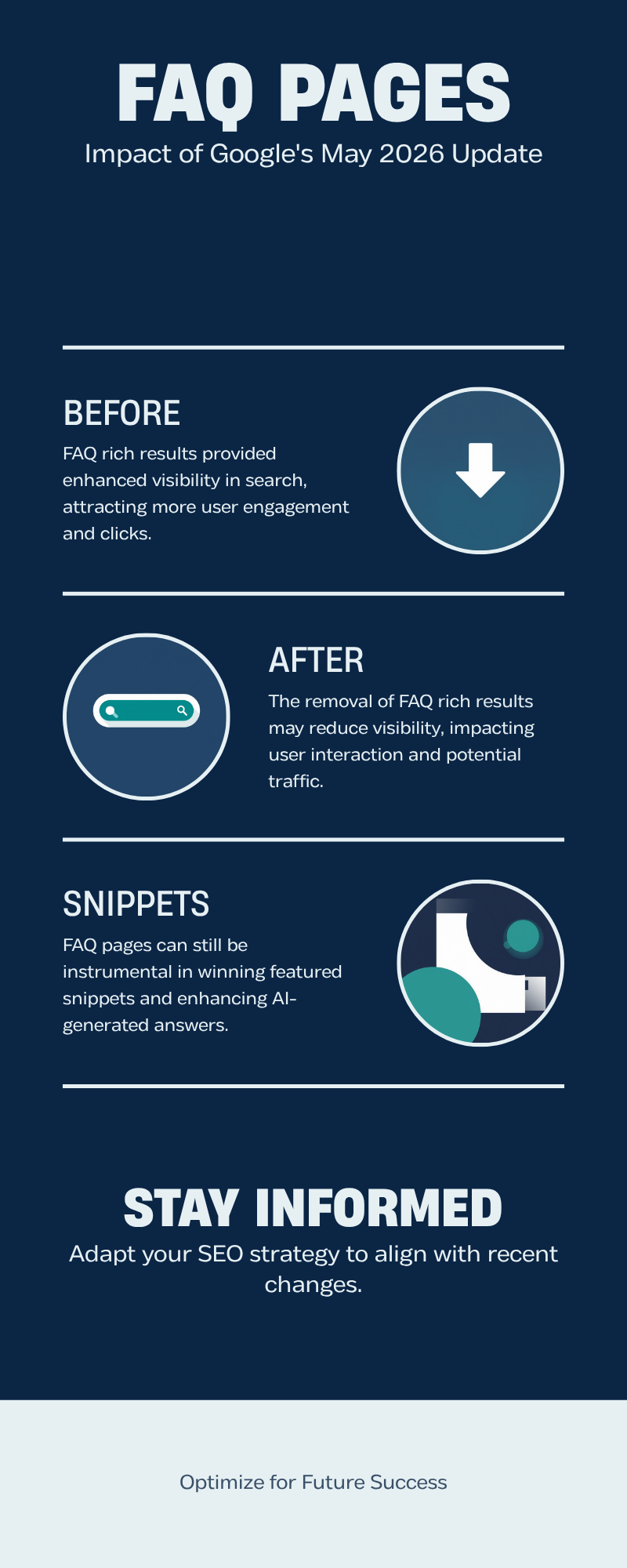
What has not changed is the underlying value of a well-written FAQ page as content. Google still needs to understand what a page is about and whether it answers a real question well, and an FAQ page structured around genuine customer questions remains one of the clearest ways to signal that. The graphic below shows exactly what changed and what did not.
Not sure whether your FAQ content is pulling its weight? Our free 30-minute consultation will show you exactly where your FAQ page stands, even if you never become a client. Book a free consultation.
Why a genuinely useful FAQ page still ranks
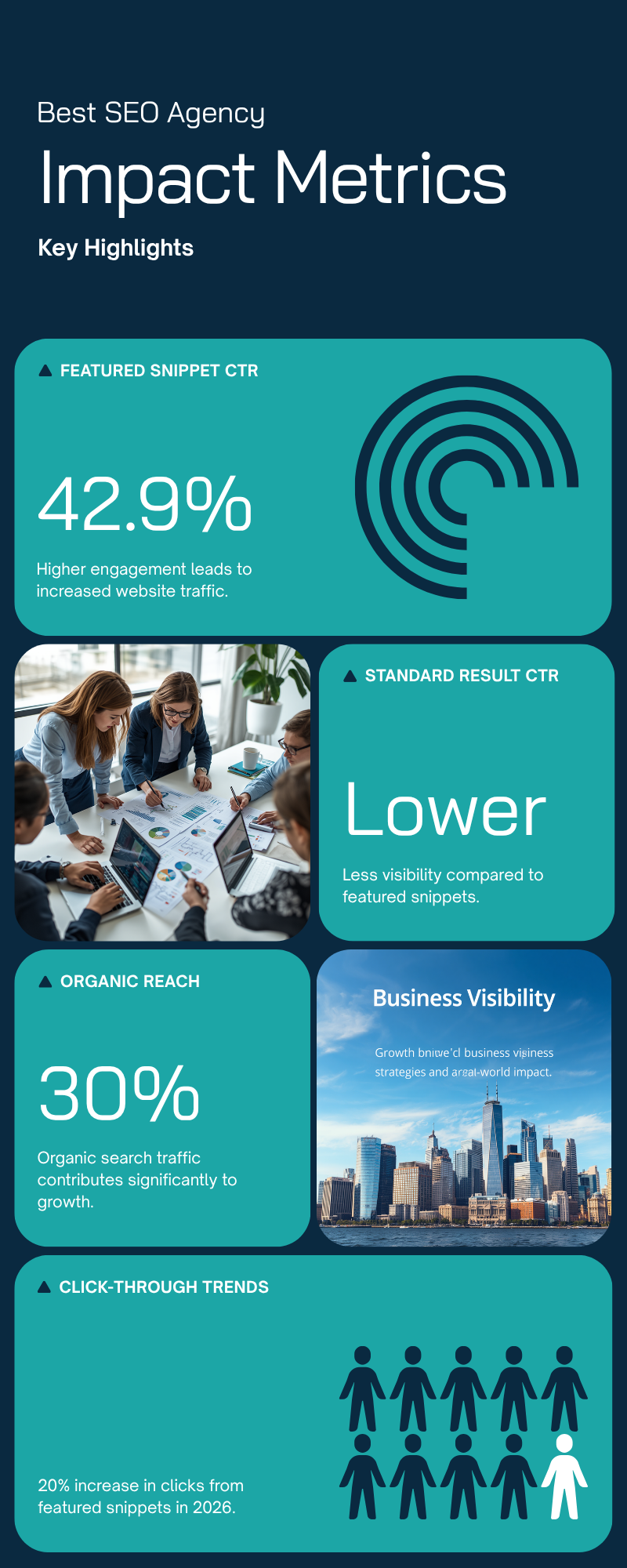
Two things replaced the old rich-result incentive, and both matter more for a Melbourne business than the dropdown ever did. First, a well-structured FAQ page is still a strong candidate for a featured snippet, the answer box that appears above the standard organic results. According to First Page Sage’s 2026 click-through rate benchmarks, a featured snippet in first position earns roughly a 42.9% click-through rate, noticeably higher than a standard first-position listing with no snippet above it. Second, pages that answer questions clearly and concisely are more likely to be pulled into Google’s AI-generated overviews and cited in AI chat answers, which is quickly becoming its own source of enquiries.
Neither of these depends on the FAQ schema markup itself. They depend on the quality of the answers. Our own guide on turning one customer question into a blog article covers the same underlying skill: starting from a real question a Melbourne customer actually asked, rather than a list a business owner invents at their desk.
There is a third audience worth writing for now too: AI assistants themselves. When someone asks ChatGPT, Google’s AI Overviews or a similar tool “how much does an SEO agency cost in Melbourne”, those systems are drawing on published web content to construct an answer, and pages with clear, well-labelled questions and concise answers are easier for them to lift accurately. A rambling paragraph gets paraphrased poorly or skipped altogether. A tight two-sentence answer to a specific question is far more likely to be quoted correctly, sometimes with your business named as the source.
How to actually write one that ranks
Start with real questions, not guesses. Pull them from your enquiry emails, your call logs, the questions your reception team fields every single week, and the “People also ask” box on Google for your main service keyword. A question phrased the way a real customer types it, such as “how much does it cost” rather than “pricing information”, matches search intent far better than corporate phrasing ever will.
Answer the question directly in the first sentence, then add supporting detail underneath. Google, and any AI system reading the page, favours a direct answer up front over a paragraph of throat-clearing before the actual information appears. Keep each answer to two or three sentences where possible. Long, rambling answers dilute the very clarity that makes a page snippet-worthy in the first place.
Group related questions under a short heading rather than listing thirty questions in one undifferentiated block. A visitor scanning for pricing information should be able to jump straight to a “Costs and payment” heading without reading through unrelated questions about scheduling or service areas first. This same grouping helps Google understand which questions belong to which topic, which in turn helps the right answer surface for the right search.
| Do this | Not this |
|---|---|
| Use the customer’s own wording as the question | Rewrite it into formal marketing language |
| Answer in the first sentence, then explain | Build up to the answer over a full paragraph |
| Group related questions under a clear heading | List every question in one long undifferentiated block |
| Update answers when prices or policies change | Leave outdated answers live for years |
| Link each answer to the relevant service page | Leave every answer as a dead end with no next step |
If your FAQ page still reads like a legal disclaimer rather than a real answer to a real question, talk to our Melbourne team. Rewriting an existing FAQ page properly is usually a one to two week job, not a full site rebuild.
Where FAQ content fits on the page, and what it costs to get right
An FAQ page performs best as both a standalone page and as a section woven into your key service pages, answering the two or three most common objections right where a customer is deciding whether to enquire. For a Melbourne business, a properly researched and written FAQ section, standalone page plus service page inserts, typically costs between $600 and $1,800 depending on how many services you offer, and takes 1 to 3 weeks from research to publish. The main thing that goes wrong is treating it as a one-off task. Customer questions change as your services, pricing and policies change, so an FAQ page needs the same periodic review as your pricing page, not a “set and forget” mentality.
The other common mistake is writing FAQ content for search engines instead of for the person asking. A page stuffed with keyword variations of the same question reads awkwardly to a human and rarely earns the featured snippet it was chasing, because Google’s systems are specifically tuned to reward content that reads naturally. Our piece on writing for humans and Google at the same time goes into more depth on striking that balance across your whole site, not just the FAQ page.
A less obvious cost is opportunity cost. Every FAQ answer is a chance to link to a service page, a case study, or a booking form at the exact moment a visitor’s specific objection has just been addressed. An FAQ page that answers questions but never points anywhere is a dead end. A well-built one turns “how much does this cost” into a direct path to a quote request, which is the difference between a page that ranks and a page that actually grows the business.
Common questions
Should I remove my FAQ schema now that it doesn’t produce rich results? No. Google’s documentation confirms the markup causes no harm even though it no longer changes how your listing looks. Leaving it in place costs nothing, is a normal part of good technical housekeeping, and may still help automated systems parse your content correctly.
How many questions should an FAQ page have? Fewer than you think. Five to ten genuinely useful, well-answered questions outperform thirty shallow ones padded out to look comprehensive. See our process page for how we research and prioritise which questions are worth answering first.
Does this apply to service pages too, or only a dedicated FAQ page? Both. A short, well-answered FAQ block at the bottom of a service page often outperforms a generic standalone FAQ page, because it answers the objection at the exact moment a customer is deciding whether to enquire about that specific service.
Will this help with voice search too? Yes, indirectly. Voice assistants tend to read out the same kind of short, direct answer that wins a featured snippet, so a well-written FAQ page is doing double duty even though voice search is not something you can optimise for separately in any meaningful way.
The dropdown is gone, but the underlying opportunity, winning the featured snippet and being cited in AI-generated answers, is arguably more valuable to a Melbourne business today than the old rich result ever was. Book a free consultation with our Melbourne team and we will show you which of your pages are FAQ-ready and which need a rewrite. No lock-in contracts, real people, real results. Free Consultation, or read more guides on our blog.
Want results like these for your business?
Book a free, no-obligation consultation with a Melbourne SEO expert.
Get a Free Consultation