Writing for humans and Google at the same time: a guide for Melbourne businesses
Most Melbourne business websites fall into one of two traps. Either the copy sounds like it was written for a person, warm and specific, but it never turns up in a Google search. Or it sounds like it was written for a search engine, stuffed with suburb names and the same three keywords, and customers bounce off it fast. Writing for humans and Google at the same time is not a trick or a piece of software. It is a learnable way of structuring and wording a page so a real customer gets what they need and Google’s systems can tell that they did. This guide sets out how to do it, with the costs, timeframes and mistakes most Melbourne businesses hit along the way.
What writing for humans and Google at the same time actually means
Google calls this “people-first content”: content built to satisfy a real reader’s need first, with search visibility as the result of doing that well rather than the goal itself. Its own guidance offers a simple test: would you be comfortable telling someone a real person wrote this page for people who wanted to read it, according to Google Search Central’s documentation on creating helpful, reliable, people-first content.
Underneath that sits a framework Google’s quality raters use called E-E-A-T: experience, expertise, authority and trust. In plain terms: has the writer actually done the thing they describe, do they know the subject, would other reputable sources vouch for them, and is the information accurate and current. None of that requires jargon. It requires specifics: real prices, real timeframes, a named author, and claims that are not vague enough to apply to any business in any city.
Not sure whether your own site leans human or leans search-engine? Our free 30-minute audit will tell you exactly where the gaps are, even if you never become a client. Book a free consultation.
Start with what someone is actually trying to do, not the keyword
Search intent is the reason someone typed a phrase into Google, and it decides almost everything about what the page should say. Someone searching “bathroom renovation cost Melbourne” wants a number, not company history. Someone searching “bathroom renovation Brunswick” is closer to booking and wants to see your work in that suburb specifically. Write the wrong page for the wrong intent and no amount of keyword placement fixes it, because Google is increasingly good at detecting when a page does not actually answer the question behind the search.
A quick check before writing: search the exact phrase yourself and look at what already ranks. If the top results are price guides, write a price guide. If they are photo galleries, a wall of text will not compete. This groundwork is exactly what a proper SEO content strategy is meant to cover before a single sentence gets written.
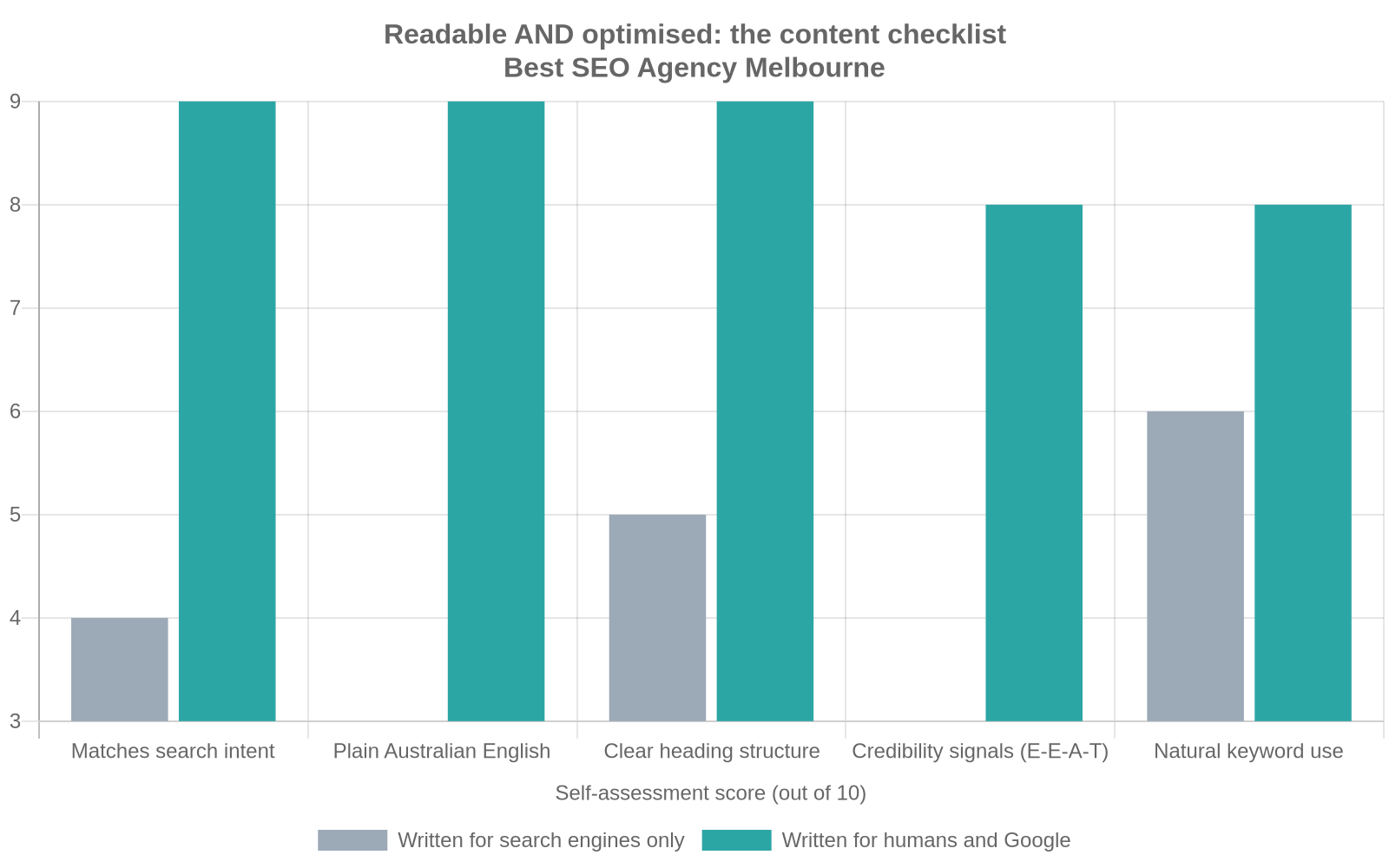
The chart above is a self-assessment we use with clients, scoring a page against five practical checks rather than treating “SEO” and “readable” as opposites.
Structure the page so both a scanning customer and Google can follow it
Nielsen Norman Group first documented this in 1997 and still cites the same pattern today: most visitors scan a new page rather than reading it line by line, and on an average page a visitor gets through only around a fifth of the words before moving on, according to Nielsen Norman Group’s research on how users read on the web. Google’s crawlers read differently to a human, but reward the same structural habits: clear headings that describe what follows, short paragraphs, and content broken into sections a reader can jump between.
The table below is a quick reference for the practical differences between the two approaches.
| Element | Written for search engines only | Written for humans and Google |
|---|---|---|
| Headings | Keyword repeated in every heading | Describes the actual question the section answers |
| Paragraph length | Long blocks, hard to scan | Two to four sentences, one idea each |
| Keyword use | Exact phrase repeated unnaturally | Phrase and natural variations used where they fit |
| Evidence | Vague claims, no sources | Specific numbers, named sources, real examples |
| Author | Unnamed or generic “admin” | Named person with real, checkable expertise |
Use the keyword the way Google rewards in 2026, not the way it did in 2012
Keyword stuffing, repeating an exact phrase over and over to signal relevance, stopped working years ago and now risks a manual penalty. The modern approach reads more like writing naturally about a topic and its related terms. If your primary phrase is “bathroom renovation Melbourne”, a well-written page will also use “renovating a bathroom”, “ensuite renovation”, suburb names where genuinely relevant, and the practical questions customers actually ask, such as cost and timeframe. Google’s systems match meaning, not just exact strings, so a page that reads naturally and covers the topic properly will usually outperform one built around a single repeated phrase.
A useful habit: read your draft aloud. If a sentence sounds like something you would never actually say to a customer standing in front of you, rewrite it. That single check catches most keyword-stuffing problems before they start.
Want a second opinion on whether your own pages read naturally or sound over-optimised? That is exactly what we check in a free consultation. Get in touch and we will walk through a page or two with you.
Build the trust signals both customers and Google are looking for
Trust is a set of specific, checkable things: a real name and photo on an author bio, an ABN and service area listed clearly, genuine customer reviews (including the occasional less-than-perfect one with a considered reply), photos of actual work rather than stock imagery, and dates on articles that get updated when the information changes.
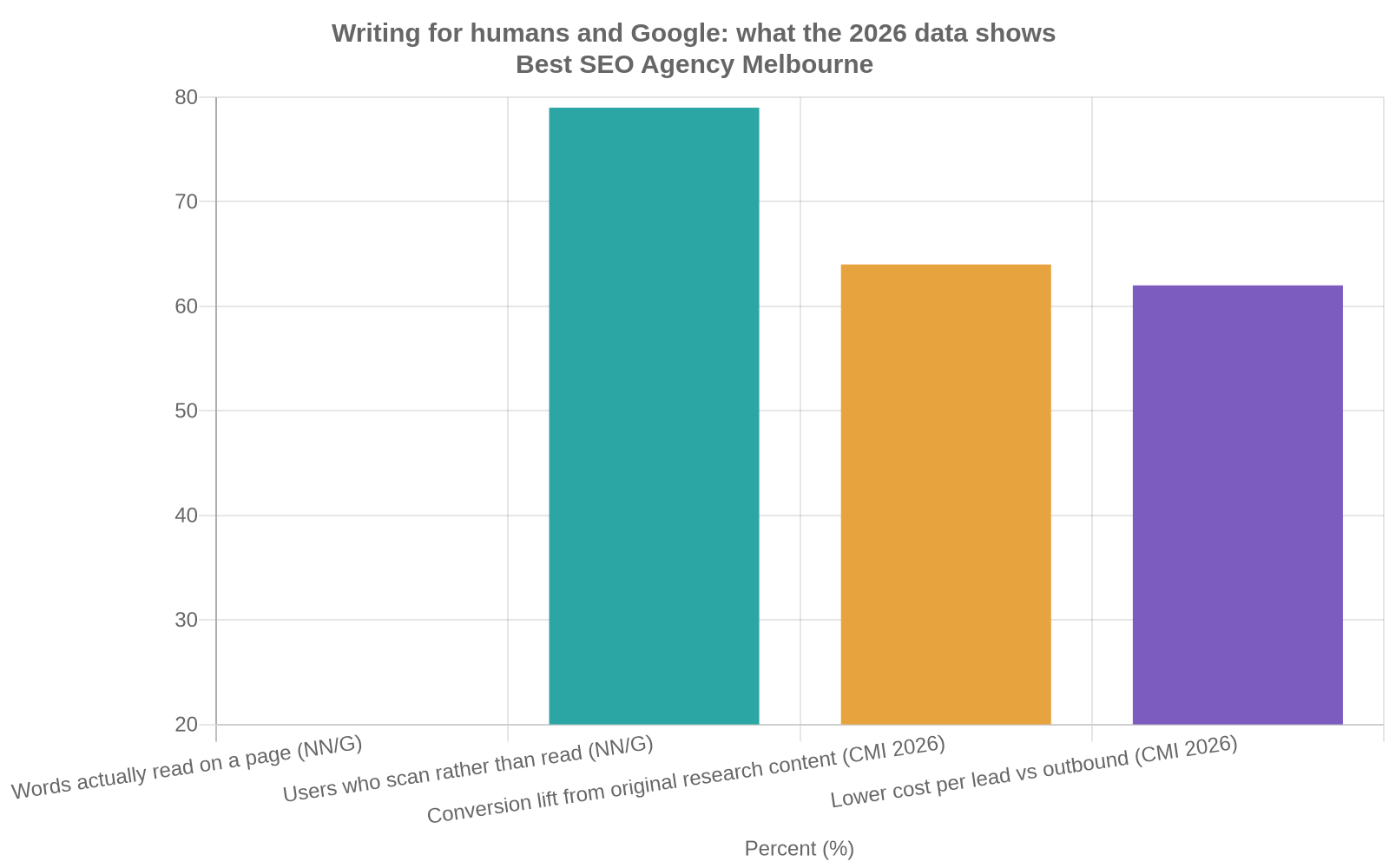
The conversion figures above come from Content Marketing Institute’s 2026 B2B research, which found that marketers publishing original data and proprietary research saw meaningfully higher conversion rates than those publishing generic, unsourced content, and that content marketing overall produced leads at a lower cost per lead than outbound channels, according to Content Marketing Institute’s 2026 B2B content marketing trends research. In practice, a page built around your own project numbers and your own customer outcomes will usually beat a page built around generic industry claims, on both fronts at once.
Readability itself is not a direct Google ranking factor. A 2021 analysis of over 750,000 ranking pages by digital agency Portent found an average reading level around Year 11, with no measurable correlation between reading level and ranking position, according to Portent’s study on how content readability affects SEO and rankings. Google is not marking you down for writing simply. The reason to write in plain Australian English is that it keeps an actual customer reading long enough to enquire, book, or buy, which is the whole point of the page.
What this costs, how long it takes, and what goes wrong
Rewriting an existing page properly, research, a structure pass, and a rewrite with real evidence, typically takes three to six hours depending on how technical the topic is. Done as part of an ongoing SEO content strategy with a Melbourne agency, expect content to be priced within a broader monthly engagement rather than sold as one-off articles, since a single optimised page rarely moves rankings without the technical and authority work underneath it. See the kind of outcomes that combination produces on our results page.
The most common mistake is not bad writing, it is inconsistency: one genuinely good page surrounded by twenty thin ones written to hit a monthly content quota. Google’s people-first guidance specifically flags content produced primarily to attract search traffic, at volume, as a pattern its systems are built to devalue. The second most common mistake is writing a page once and never touching it again; a page with 2023 pricing sitting on a 2026 website damages trust the moment a reader notices. If you are still comparing how a Melbourne agency prices this kind of work, our guide on how to choose an SEO agency in Melbourne without signing a 12-month mistake covers the questions worth asking before you commit.
Frequently asked questions
Will simplifying my website copy hurt my rankings?
No. As the Portent research above shows, reading level has no measurable link to ranking position. Plain language keeps customers reading, which supports the engagement signals Google does care about.
How many keywords should I use on one page?
One primary phrase and two or three natural variations is usually enough. Trying to rank one page for a dozen unrelated phrases is a common reason content ends up sounding unnatural. Our FAQ section covers more questions like this.
Should every blog post link back to a service page?
Where genuinely relevant, yes. A forced link reads as spammy, but a link that helps a reader take the next logical step is good for both the reader and the page.
Short on your next topic? Our guide on how to turn one customer question into a blog article sets out a simple way to find it.
Getting the balance right
Writing for humans and Google at the same time comes down to one habit more than any other: answer the real question a real Melbourne customer has, in plain language, backed by specifics they can check. Keyword placement and heading structure matter, but they are the scaffolding, not the point. Get the substance right first and the technical side becomes far easier to fit around it.
Book your free consultation. No lock-in contracts, we reply within 24 hours, and it is a Melbourne-based team on the other end. Get started here. For more practical guides like this one, visit our SEO blog.
Want results like these for your business?
Book a free, no-obligation consultation with a Melbourne SEO expert.
Get a Free Consultation