How to Read an SEO Report Without a Marketing Degree: A Melbourne Business Owner’s Guide
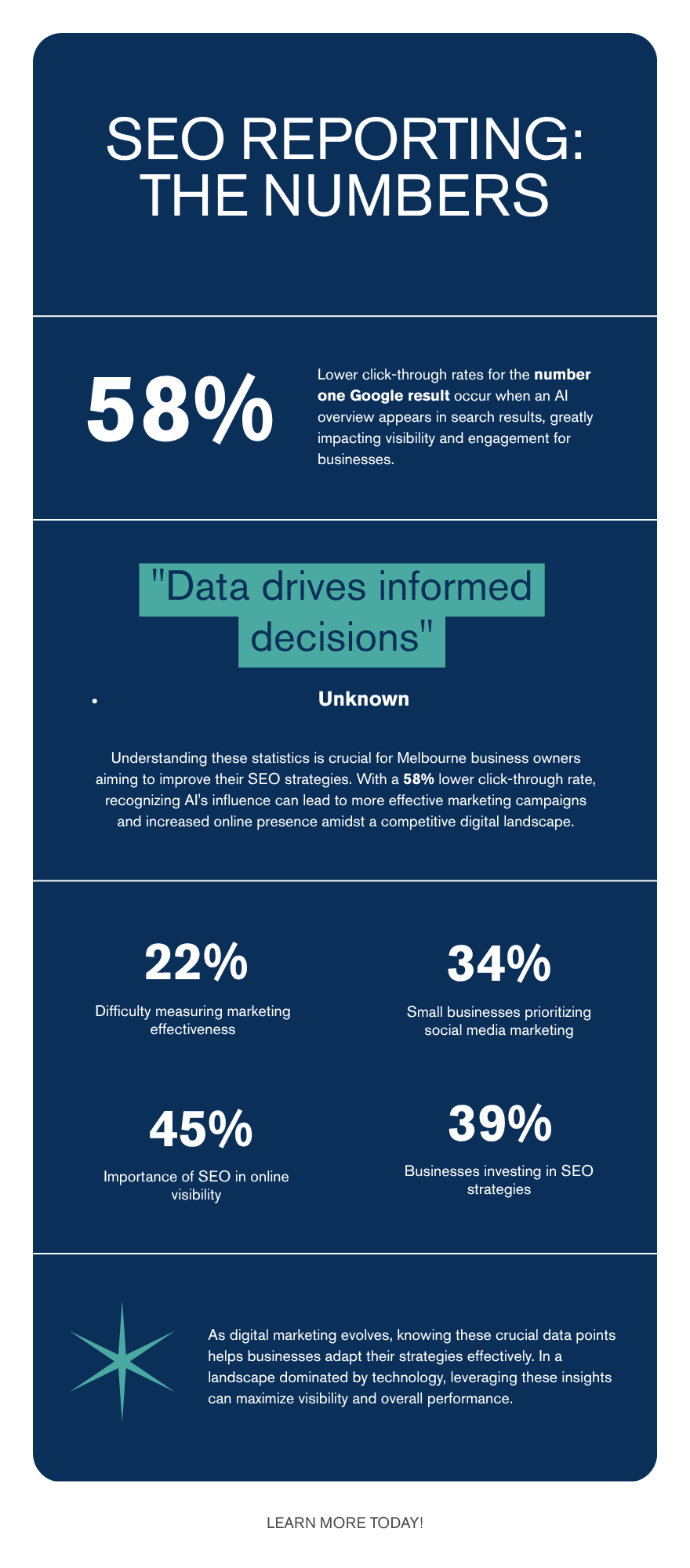
Your SEO agency has just sent through this fortnight’s report. It runs to twelve pages, full of graphs and terms like organic sessions and keyword rankings, and you’ve got about four minutes before your next meeting. If you’ve ever nodded along on a reporting call without actually knowing whether the numbers were good or bad, you’re not alone. Nearly a quarter of Australian small business owners, 22%, say it’s difficult to tell what’s working in their marketing, according to a 2026 Constant Contact survey. This guide breaks an SEO report down into the four numbers that actually matter, shows you what a proper report should include, and flags the warning signs that separate a strategy that’s working from one that’s quietly going nowhere. None of it requires a marketing degree, just a clear idea of what each number is actually telling you.
What should actually be in your SEO report
A proper SEO report isn’t a folder of screenshots with a logo stuck on the cover. It should answer one plain question: is the money you’re spending on search engine optimisation turning into phone calls and enquiries? At a minimum, look for four things every time, whether your agency reports monthly or, like ours, fortnightly. If a report only ever shows the numbers that make last month look good, that’s a sign to start asking questions.
| What to check | What it actually means | Good sign | Warning sign |
|---|---|---|---|
| Organic traffic | How many people found your site through an unpaid Google search | Steady growth month on month, even if slow | Traffic up but nothing else moves |
| Keyword rankings | Where your pages sit in Google for the searches your customers use | Rankings improving for terms with buyer intent, such as “plumber Richmond” | Rankings for random or branded terms only |
| Conversions | Enquiries, calls or form fills that came from organic search | A visible link between traffic and enquiries | No mention of enquiries at all |
| Technical health | Whether Google can actually crawl, read and load your site properly | Issues flagged with a fix date given | Same unresolved issues, report after report |
If your current report is missing any of these four, that’s not necessarily a red flag on its own, but it does mean you’re only getting part of the picture.
Not sure if your current report stacks up? Book a free 30-minute consultation and site audit with our Melbourne team. There’s no obligation, and you’ll walk away knowing exactly where you stand, even if you don’t become a client.
The four numbers that actually matter
Once you know what should be in the report, the next skill is reading it in the right order. Here’s the sequence we walk clients through every fortnight.
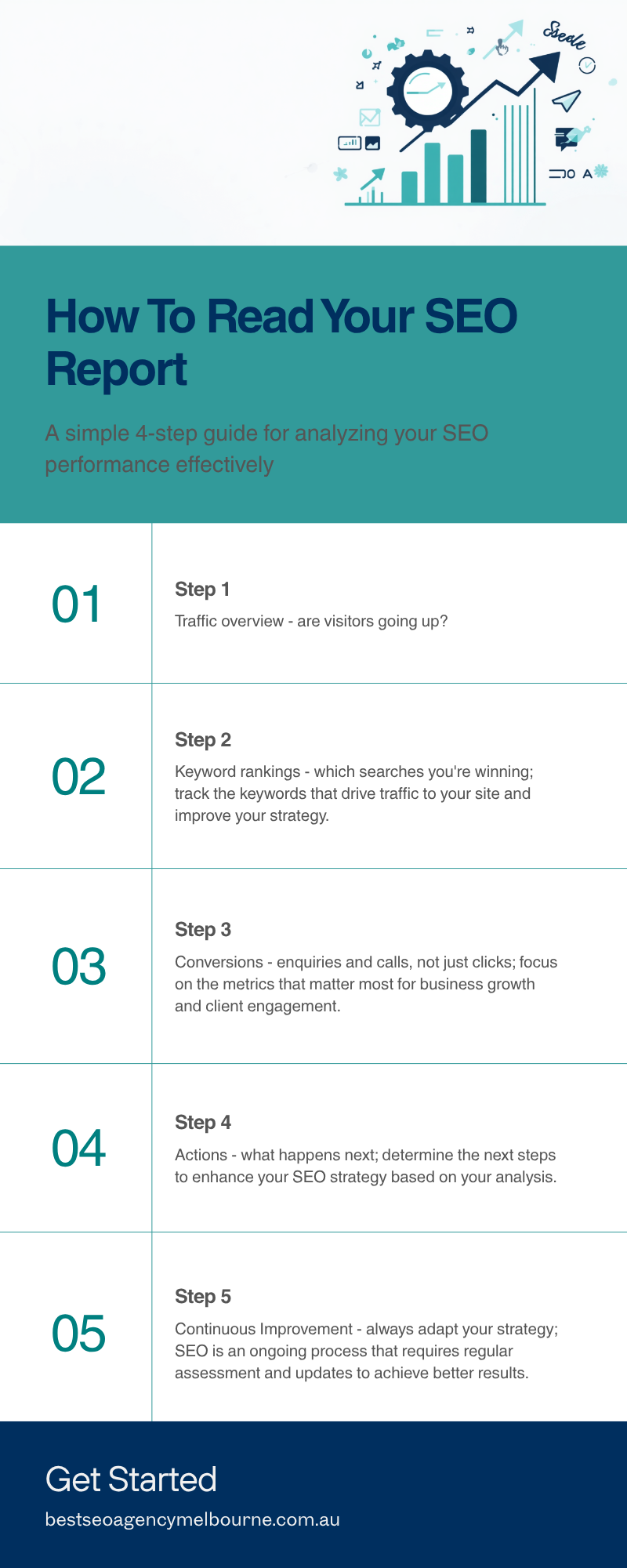
1. Start with traffic direction, not the exact number
Don’t get hung up on whether you had 812 or 840 visitors last month. What matters is the trend over three to six months. A Melbourne trades business we work with in Port Melbourne cared less about the raw number and more about the line trending up, quarter on quarter, once seasonal dips around Christmas and the mid-year slowdown were accounted for. A single month rarely tells you anything on its own.
2. Check rankings for terms that actually pay the bills
Ranking first for your own business name is not a win, you’d rank for that anyway. Look for movement on the searches a real customer would type before they’re ready to buy, things like “family lawyer Southbank” or “emergency electrician Brunswick”.
3. Follow traffic through to conversions
This is the step most reports skip, and it’s the one that matters most. Traffic without enquiries usually means the wrong pages are ranking, the content doesn’t answer the reader’s actual question, or there’s a trust issue further down the page. We’ve written before about why a blog can get traffic but no enquiries, and the fix is rarely more traffic, it’s usually a content or page-level problem.
4. Read the actions, not just the outcomes
A report without a “what happens next” section is really just a screenshot dump. Every fortnightly report should end with two or three specific actions, who’s doing them, and roughly when you’ll see the result.
Why a number one ranking doesn’t mean what it used to
Rankings alone used to be the whole story. In 2026, they’re not. Google now shows an AI-generated summary, called an AI Overview, above the traditional results for a large share of everyday searches. Ahrefs analysed 300,000 keywords using Google Search Console data and found that when an AI Overview appears, the click-through rate for the page ranking first drops by 58% compared with a normal search results page, in research published in February 2026. In plain terms, for every 100 clicks a page used to earn from sitting at position one, it now earns roughly 42.
That doesn’t mean SEO stopped working. It means a fortnightly report showing “still ranking number one” isn’t enough on its own. Ask your agency to show actual clicks and impressions from Google’s own Search Console Performance report alongside the ranking position, so you can see whether that top spot is still delivering visits.
If your fortnightly report only shows rankings and doesn’t break down clicks, impressions or enquiries, it’s worth asking why. Request a free report review and our Melbourne team will walk you through what your current numbers are actually telling you, at no cost.
Red flags: when a report is hiding a problem
Most SEO reports aren’t dishonest, they’re just incomplete, and incomplete can hide a problem for months if you don’t know what to look for. Watch for these five patterns.
- Vanity metrics only. Impressions, a “visibility score”, or social shares with no mention of enquiries.
- No month-on-month comparison. A single snapshot tells you nothing about direction.
- Jargon with no plain-English explanation. If you need a glossary to read your own report, ask for a rewrite.
- Technical issues that never get fixed. The same broken pages flagged report after report, with no resolution date.
- No named next action. Every report should end with what’s being done next, not just what happened last fortnight.
This matters more than it might seem. The ACCC has flagged manipulative or misleading conduct in digital markets, including advertising and reporting claims, as an enforcement priority for 2026. A reputable agency has nothing to hide behind a chart, and should be happy to explain any number in your report in one sentence, without you having to ask twice.
What this costs, how long it takes, and what goes wrong
Cost. Melbourne SEO retainers commonly range from around $800 to $3,500 a month, depending on how competitive your industry is and how much content and technical work is involved. Be wary of anything priced far below that range, it usually means thin, templated work rather than a strategy built around your actual customers.
Timeframe. Most Melbourne businesses see the first ranking movement within 60 to 90 days, with noticeable traffic and enquiry growth by months four to six. Anyone promising page-one rankings in two weeks is either exaggerating or planning something Google will eventually penalise.
What goes wrong. The most common failure isn’t a bad strategy, it’s a bad contract. Locking into 12 months with an agency you can’t easily leave removes your ability to act on a report that isn’t delivering. A close second is an agency reporting on keywords nobody actually searches for, padding out the rankings table to look busy while the numbers that matter go quietly unmentioned. We’ve covered agency selection in more detail in how to choose an SEO agency in Melbourne without signing a 12-month mistake, including the six questions worth asking before you sign anything.
Quick questions about SEO reporting
How often should I actually receive a report?
Fortnightly is a good middle ground for most small businesses, frequent enough to catch problems early, not so frequent that you’re paying for admin instead of results. Monthly is acceptable if the report is genuinely thorough.
What if my traffic is up but enquiries aren’t moving?
That’s usually a page or content problem rather than a traffic problem, see the section above on following traffic through to conversions.
Can I ask my current agency to explain a report line by line?
Yes, and you should. Any agency worth paying will walk you through their reporting without charging extra for the conversation. For more on what to expect, see our frequently asked questions.
The takeaway
A good SEO report should leave you more confident, not more confused. Ask for the four numbers, traffic, rankings, conversions and next actions, expect plain language over jargon, and treat a top ranking as one signal among several rather than the whole scorecard. If you’d like someone to sit down and walk through your own report line by line, free of charge and with no lock-in contract, get in touch for a free, obligation-free chat. For more plain-English guides written for Melbourne business owners rather than marketers, visit our blog and read the next one on your lunch break instead of scrolling.
Want results like these for your business?
Book a free, no-obligation consultation with a Melbourne SEO expert.
Get a Free Consultation